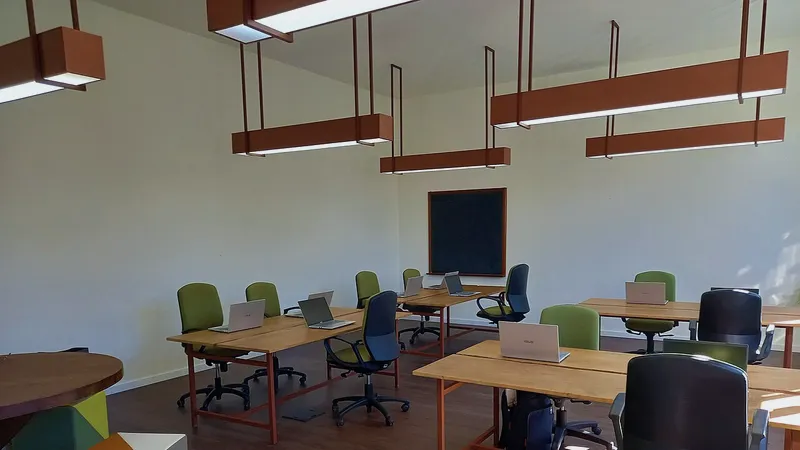
What IT support does a 10 person office need?
A ten-person Dallas office needs seven things: Microsoft 365 or Google Workspace with multi-factor authentication on every account, business-class laptops that are actually managed, a business router and firewall rather than the box the internet company left, Wi-Fi that covers the whole suite, backups of both devices and cloud data, endpoint protection, and one accountable person to call.
Answered by Anthony Omini, Cross River Tech, Dallas

Key takeaways
- Seven essentials: cloud email with MFA, managed business laptops, a real firewall, proper Wi-Fi, backups of devices and cloud data, endpoint protection, and one accountable contact.
- Cloud email does not back itself up the way most owners assume, and at ten people that gap is the most common serious hole I find.
- The internet company's box is a router, not a firewall, and one access point rarely covers a whole suite properly.
- Realistic support demand at this size is a handful of hours a month, most of it remote, plus maintenance nobody thinks to ask for.
- A server, a full-time IT hire and enterprise security tooling are all usually overkill at ten people in Dallas.
What IT support does a 10-person office need?
Seven things, and none of them are exotic. Cloud email on Microsoft 365 or Google Workspace with multi-factor authentication turned on for everybody. Business-class laptops that someone is actually managing rather than ten machines bought separately over four years. A business router and firewall, not the combined box the internet provider dropped off. Wi-Fi that genuinely covers the whole suite. Backups of both the devices and the cloud data. Endpoint protection that reports somewhere. And one accountable contact who picks up when something breaks.
Ten people is a real threshold, not because ten computers are difficult, but because ten people produce joiners and leavers, shared files, a printer everybody depends on, and enough email traffic to attract the attention of people trying to redirect a payment. Informal arrangements that worked at four start visibly failing here.
The rest of this lays out that build item by item, what it costs in support hours, and what I would deliberately leave out. I do this work across Dallas and the wider metroplex, remote-first because it is faster and cheaper for you, onsite by appointment when something needs hands.
What is essential, what is optional and what is overkill?
Here is the whole build sorted honestly. The middle column is where most sales conversations quietly move things into the left one.
| Essential at ten people | Nice to have | Overkill at this size |
|---|---|---|
| Microsoft 365 or Google Workspace, company-owned tenant | Higher license tier for advanced email filtering | Running your own mail server |
| Multi-factor authentication on every account | Hardware security keys for admins | A separate identity platform |
| Business-class laptops on a standard model | A spare loaner machine on the shelf | Thin clients or virtual desktops |
| Business router and firewall | A second internet circuit or cellular failover | Redundant firewalls in a cluster |
| Two or three ceiling access points, cabled | Separate guest network with its own bandwidth cap | A controller appliance in a rack |
| Backup of cloud mail and files | Longer retention than the default | Off-site tape rotation |
| Managed endpoint protection | Security awareness training for staff | A monitored security operations center |
| Documented accounts and admin ownership | A shared password manager for the team | Formal change control |
| One accountable IT contact | A quarterly review meeting | A full-time internal IT hire |
Two entries deserve a note. A file server is not on the essential list, and for most ten-person Dallas offices it should not be: SharePoint, OneDrive or Google Drive does the job with less to maintain and nothing to fail in a closet. The exception is design, architecture and engineering work with very large files, where local storage still wins, and any practice whose software insists on a server. A full-time IT hire is genuinely overkill at ten people; the honest comparison is in hiring an internal IT person versus using an MSP.
What does the email and identity side look like?
Start here, because everything else depends on it. At ten people you want one tenant, owned by the business, with named accounts for every person and nothing shared.
- The company owns the tenant. Not a former employee, not a web designer, not a previous IT provider. There should be at least two global administrator accounts, and you should know whose they are.
- Multi-factor authentication for everyone, no exceptions for the owner. The owner's mailbox is the one worth attacking, because it is the one that can authorise a payment.
- No shared logins. The shared info@ or reception login is convenient and it is how offboarding fails. Use a shared mailbox with individual access instead.
- Licences that match actual people. Ten people should not be paying for fourteen licenses, and I find that in most offices I take over.
- Mailbox rules checked periodically. A hidden forwarding rule is the classic sign of a compromised account, and it is invisible unless somebody looks.
The security settings worth turning on, in order, are in Microsoft 365 security for a small business. Most of them are included in licenses offices already pay for and simply were never switched on. I handle this as part of Microsoft 365 and Google Workspace support, and it is usually the first thing I fix when I take over an office.
What network and Wi-Fi does a ten-person suite need?
A business router and firewall, a small managed switch, and two or three ceiling-mounted access points cabled back to the IT room. That is it, and it is where the most money gets wasted in both directions.
The single most common problem I find in a Dallas office of this size is that the network is the box the internet company installed, sitting on a shelf, doing routing, firewalling and Wi-Fi all at once for a suite it was never designed to cover. It works for four people in one room. At ten people spread across a suite with walls, it produces exactly the symptoms owners describe as "the internet is slow": drops on video calls, a printer that vanishes, dead corners.
What fixes it is unglamorous. A proper firewall at the edge, so you have a device that can actually be configured, updated and inspected. A managed switch so ports can be diagnosed. Access points on the ceiling, positioned for the floor plan rather than for where the cable happened to be, and cabled with Cat6 rather than daisy-chained wirelessly. If the suite has never been cabled properly, that is a data cabling job and it is worth doing once, correctly, particularly during a build-out. The placement side is covered in office Wi-Fi access point installation.
What you do not need at ten people: a rack full of redundant equipment, a wireless controller appliance, or enterprise licensing on the firewall. A small business firewall with current firmware and sensible rules is the right answer.
What about backups, and does cloud email back itself up?
No, not the way most owners assume, and this is the most common serious gap I find in ten-person offices. Microsoft and Google keep your service running and protect against their own failures. They are not a backup of your content against your own mistakes.
Here is what that means concretely. If somebody deletes a folder in SharePoint and nobody notices for a few months, the retention window may well have passed. If a compromised account deletes a mailbox's contents deliberately, the recovery options are limited and time-bound. If ransomware encrypts files that then sync to the cloud, the sync is faithful. Version history helps in some of these cases and not in others, and none of it is under your control.
What a ten-person office should have:
- A third-party backup of the cloud tenant. Mail, files, calendars and contacts, on your own retention schedule.
- Backup of anything living only on a laptop. Ideally nothing does, but reality disagrees, so redirect the desktop and documents folders into the cloud and back that up too.
- Backup of a server, if there is one. Local for speed and a copy off-site, and check the off-site copy is actually completing.
- A restore test that somebody actually performs. Not a green tick on a dashboard. Pick a file, pick a mailbox, bring them back, write down that it worked.
That fourth point is the one that separates a backup from the feeling of having a backup. I do it as routine under a backup and disaster recovery arrangement, and it is the first thing I would want proven in any office I inherit.
How much IT support does a small Dallas office really need?
Less reactive support than people expect, and more maintenance than they realise. For a healthy ten-person office, the visible support demand is a handful of hours a month: password problems, a printer, a laptop behaving oddly, a new starter, someone leaving, a question about a file.
The invisible half is roughly the same size and it is what actually keeps the office out of trouble:
| Work | How often | Who notices if it is skipped |
|---|---|---|
| Operating system and application updates, verified | Monthly | Nobody, until an incident |
| Backup checked and a real restore tested | Monthly or quarterly | Nobody, until you need it |
| Endpoint protection alerts reviewed | Ongoing | Nobody |
| Accounts and admin rights reviewed | Quarterly | Nobody |
| Licences reconciled against real people | Quarterly | Your accountant, eventually |
| Firewall firmware and rules | Quarterly | Nobody |
| Device age and replacement planning | Yearly | Everybody, all at once |
Put the two halves together and a ten-person office consumes real, ongoing attention. That is why this size is usually the point where a plan starts to beat hourly billing: not because the fixes cost more, but because the maintenance column only ever gets done when someone is being paid to do it whether or not anything is broken. The worksheet for deciding is in on-call IT versus a managed plan.
What does this cost in Dallas?
Two honest answers, because there are two ways to buy it.
Hourly. My published break/fix rates are $100 an hour remote and $150 an hour onsite during business hours, Monday to Friday, 8 AM to 5 PM Central, and $150 remote and $225 onsite after hours, weekends and holidays. One-hour minimum, no agreement. That suits an office that wants help when things break and is willing to buy maintenance deliberately rather than continuously.
Monthly. Managed IT is quoted per user per month or per device per month, month to month, cancel any time. I quote it after a short conversation, because ten people with ten laptops and no server is a different number from ten people with fifteen devices, a server and specialised practice software. As a typical market range, small-business managed IT around Dallas is commonly quoted somewhere around $100 to $175 per user per month; that is the market, not my price.
Separate from support, budget for the things themselves: laptops on a replacement cycle, licenses, the firewall and access points, cabling if the suite needs it, and the backup service. Those are capital and subscription costs rather than support, and lumping them together is how IT budgets go wrong. What a small business should budget for IT each year breaks the categories apart, and every rate I publish is on the pricing page.
What order should a ten-person office fix things in?
If you are inheriting a mess rather than building from scratch, sequence matters. This is the order I work in, because each step makes the next one safer.
- Multi-factor authentication on every account, owner first. Cheapest, fastest, prevents the most damaging thing that happens to small offices.
- Admin ownership and account clean-up. Confirm the business owns the tenant and the domain, add a second admin, remove leavers, kill shared logins.
- Backups, then a restore test. Cloud data and any server. Prove it works before trusting it.
- Endpoint protection and patching. Get every machine current and reporting to one place.
- The firewall. Replace the internet company's box, update firmware, close what should not be open.
- Wi-Fi and cabling. The most visible fix, deliberately not first, because the invisible ones matter more.
- Documentation and a replacement plan. Write down what exists and when each machine is due for replacement.
Most of that first block can be done remotely in a few sessions. The security shortlist behind it is in cybersecurity basics for a Dallas small business, and when the office grows, what changes next is in what changes when a Dallas office grows past 25 people.
If you have ten people and you are not sure which of these you already have, tell me your headcount, your software and what has been going wrong. I will tell you which of the seven essentials are missing and what it takes to close them, whether you hire me or hand the list to somebody else.
Questions people ask
What IT support does a 10 person office need?
Seven essentials: Microsoft 365 or Google Workspace with the tenant owned by the business, multi-factor authentication on every account, business-class laptops that are actively managed, a business router and firewall, two or three cabled ceiling access points, backups of both devices and cloud data with tested restores, and one accountable person to call. Endpoint protection and documented admin ownership sit alongside those.
Does a 10-person office need a server?
Usually not. SharePoint, OneDrive or Google Drive handles shared files for most Dallas offices at this size with far less to maintain and nothing to fail in a closet. The real exceptions are design, architecture and engineering work with very large files where local storage is genuinely faster, and practices whose software requires a server. If you have one already, it needs backup, patching and a replacement plan.
Is Microsoft 365 backed up automatically?
Not in the way most owners assume. Microsoft and Google protect their own infrastructure and keep the service running; they do not protect your content from your own deletions, a compromised account, or ransomware that syncs. Retention windows are limited and time-bound. A ten-person office should add a third-party backup of mail, files, calendars and contacts, on its own retention schedule, and test a real restore.
How much IT support does a small Dallas office really need?
The visible part is a handful of hours a month: passwords, printers, a new starter, a laptop misbehaving. The invisible part is about the same size and matters more: verified patching, backup restore tests, endpoint alerts, quarterly account and license reviews, firewall firmware, and yearly replacement planning. Ten people is usually where a monthly plan starts beating hourly, because the invisible half only happens when someone is paid to do it.
What does IT support cost for a 10-person office in Dallas?
Hourly with me is $100 remote and $150 onsite in business hours, $150 and $225 after hours, with a one-hour minimum and no agreement. Managed IT is quoted per user or per device, month to month, after a short conversation. Across the wider Dallas market, small-business managed IT is commonly quoted somewhere around $100 to $175 per user per month, separate from hardware, licenses and cabling.
What should a ten-person office fix first?
Multi-factor authentication on every account, starting with the owner, because it is the cheapest step and prevents the most damaging thing that happens to small offices. Then confirm the business owns its tenant and domain and clean up accounts, then backups with a proven restore, then endpoint protection and patching, then the firewall. Wi-Fi and cabling come after those, even though they are the most visible complaint.